Traditions
We have 11 national holidays, which leave offices and bureaus empty of people – Lithuanians like to celebrate. Some of the holidays are celebrated together with the rest of the world: together we celebrate the New Year’s Day, together we sit at the table for Easter, have a day-off on the International Labour Day, and exchange presents at Christmas.
Other holidays are purely Lithuanian – join us in celebrating them: the Independence Day on February 16, the Independence Restoration Day on March 11, Joninės, or Rasos (St. John’s Day) on June 24, the King Mindaugas (our only king) Crowning Day on July 6, Žolinė (stemming from žolynai, which means herbs, as herbs are sanctified on that day; Assumption of Mary Day) on August 15, and All Saints’ Day on November 1. We also celebrate Užgavėnės (Shrove Tuesday), a call for spring, and Kūčios (Christmas Eve), a quiet and solemn dinner with rituals and fortune-telling in the circle of family and closest friends.
We, the Balts, like many other old cultures, have built our calendar system on our knowledge of natural phenomena and celestial bodies playing a role in human survival, and on old myths and the holy sanctity. Neither Christianity and ecclesiastical dogmas nor liturgy have made us abandon the rituals, customs and beliefs inherited from the old times – they are still alive. That’s why we continue to believe in the magic protective power of herbs and glorify them on Palm Sunday, Whit Sunday and Žolinė, and visit tombs of our loved ones on All Souls’ Day to show them special respect.
JONINĖS
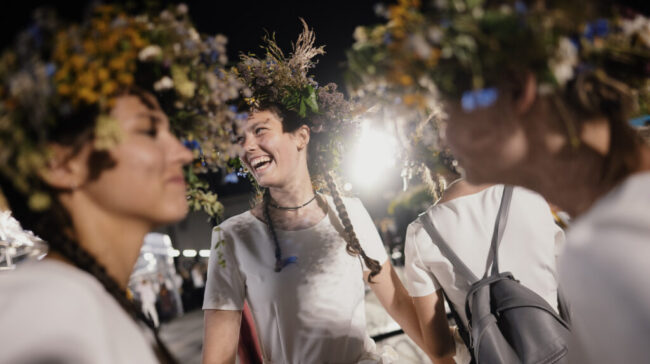
Celebrations of Joninės or St. John’s Day (June 24), also called Rasos (Dew Holiday) or Kupolė, date back to the distant pagan times. Girls believe that morning dew turns magic on this shortest night of the year; therefore, they wash their faces with dew to freshen them up. Bonfire is an important ritual on this day, a salute to the Sun. Special importance is attached to water: hexes bathing in lakes and rivers on this night enchant the water and it can make you look younger, help get married sooner, or cure of long-standing illnesses. A bouquet of herbs collected on the Joninės night also has magic powers. Herbs are used for making wreaths and telling fortune. Another important characteristic of the shortest night of the year is to look for a blossom of a fern, although everybody knows that the fern does not blossom at all. People used to believe that one has to be strong-willed, resolute, mature and unselfish to succeed in finding a fern blossom.
ALL SAINTS’ DAY and ALL SOULS’ DAY
All Saints’ Day and All Souls’ Day (November 1 and 2) are the days, when all Lithuanians go to cemeteries to put up candles on the tombs of their loved ones, also on unvisited tombs, and to say a prayer, in the belief that this will help to keep the link between the living and the dead, as All Souls’ Day is a special time, when souls come back home. These are quiet and peaceful days and have nothing to do with Halloween, the feast of hosts, celebrated in other parts of the world.
KŪČIOS (CHRISTMAS EVE)
Kūčios, or Christmas Eve (December 24) is a ritual dinner, for which family members and closest relatives gather. Among inseparable meals of this dinner are kūčiukai (minute buns), oatmeal kisielius (Kissel, sweet drink thickened with starch), and poppy-seed milk. The Christmas Eve dinner must consist of twelve dishes – one for each month of the year – and everyone must taste each of the dishes for the coming year to be wealthy. After the dinner, dishes are not removed from the table – they are left there for the souls, who come at night. The dinner is followed by fortune-telling games, e.g. straws are drawn out from under the tablecloth – the longer the straw, the longer one’s life. Young people try to foretell if their marital life will be a success.
UŽGAVĖNĖS (SHROVE TUESDAY)
Užgavėnės (Shrove Tuesday) is a winter holiday, at which people ask the winter to leave and the spring to come. People eat much on this day: the most common food is fatty pancakes and yeasty doughnuts. Masqueraded as different characters like beggars or gypsies, or wearing masks of animals (bears, cranes, goats), people visit their neighbours. Before the end of the feast, people burn, throw into water or sledge down a hill the jackstraw of the old maid Morė, the symbol of winter’s hardships. After Užgavėnės, spring is said to be within a hand’s reach.
KAZIUKAS FAIR
It is an annual folk arts and crafts fair usually held on the Sunday nearest to St. Kasimir’s day, 4 March. It is a joyful folk arts and crafts festival occupying the main streets of Vilnius and Kaunas where one can purchase unique hand-made foodstuffs and souvenirs. The fair’s specialty is verba (Palm Sunday bouquets), made of dried colourful flowers and herbs. Kaziukas festival is an echo of historical Lithuanian ethnographic tradition. According to historical sources, Kaziukas fair dates back to the beginning of the 17th century.